In order to get on the air, I need (besides getting my license) a radio. But I also need an antenna. I would like to eventually make my own antennas (and radios!) but first I just wanted something that would get me on the air for a taste of receiving and transmitting.
My first antenna is a 17” telescoping whip. Picture a portable radio in your head, and its metal antenna that pulls up, then make it WAY bigger. That is basically what I have.
The antenna screws into one side of the base pictured below, and a spike screws into the other side of it to stick it into the ground, and a coax cable goes from the side to my radio. There was just one problem…
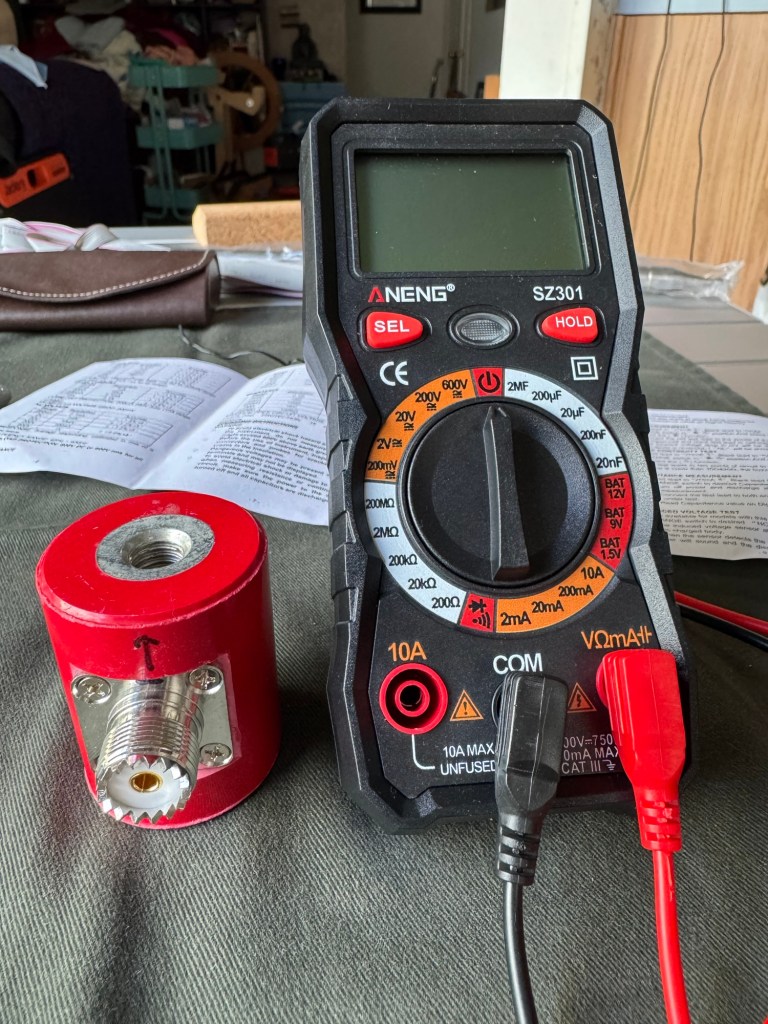
Some of these cheap antenna sets has a little metal tab to show which end to screw the spike into, because the threads on both ends look exactly the same. The one I received is missing that.
In order to determine which end actually gets the little air slinkies to come in and slide down the cable to my radio, I had to learn to use another new toy: a multimeter.
As indicated by the MULTI part of multimeter, it does multiple things – you can see if current is live on an outlet or if a circuit is intact & will allow electricity through, and things that I don’t have the skills to explain yet. In this case I needed to do a continuity test to determine the end that would allow the signal to go from the antenna to the cable.
Thanks to the internet and specifically this video, I was able to easily figure it out:
Now, I could have put everything together and then tried to tune in a station on the radio, then taken it apart and tried it the other way if it didn’t work, but this was quicker and easier to do inside in the comfort of air conditioning! I am glad that I knew I would need a multimeter and had already ordered one.
Basically you plug in the leads, turn the knob to the little wi-fi-looking symbol (it’s not though, I think it means it plays a sound) and then touch the leads to the center post where the coax gets connected and then touch the inside of the ends. It makes a SKREEE sound when continuity is detected.
Once I had performed the test, I used a Sharpie marker to put a “this end up!” arrow in it. I might add another in case that rubs off.
Then I went out into my backyard and verified that my radio could in fact pull voices from the ether. I can’t wait to be able to play with it more seriously this weekend!
The neat thing about this antenna is that you can extend it all the way out to make it get one band and then shorten it by collapsing sections to get others. I will have to learn to use a second tool I got – the NanoVNA, which I will use as what’s called an antenna analyzer- to figure out what lengths work with which bands. It’s very versatile!
Next post I will introduce my radio… or rather, radios, because I did end up ordering a second radio already, that covers a band my first radio does not. More on that later.
 Skulleigh.com