Blog

  • Sounds and Sights from Space

    I have some catching up to do, but I am going to start from where I am right now, and then post about what I have been doing since my last post in August. The short version is that I have gotten my radio(s) working, and have even gotten on the air with both POTA (Parks on the Air) and a DX (a direct contact that was a long distance away).

    What I did tonight that I think was fun and exciting was trying to get an image from SPACE. There’s a group called ARISS – Amateur Radio on the International Space Station – that is aimed at kids to get them interested in science and technology using the frame work of making ham radio contacts with astronauts. For World Space Week they are doing an event this weekend where a transmission of SSTV signals are being sent from the ISS using the 2 meter VHF band. SSTV is Slow Scan Television, which is a way to send still pictures over the air, mostly by amateur radio these days. So they are sending a couple of different images for radio operators to “hear” and use software to decode the sounds into images.

    To receive this I installed an app on my iPhone to track the position of the ISS so I know when it passes over me. I also have an app on my phone to decode the sounds into the images.

    Since VHF signals are line-of-sight – in other words, I need a clear view of where the Station is in the sky, with no buildings or land in the way, I was afraid that the arc the Station was going to take would not allow me to get the signal where my house is. So I took my handheld VHF radios (I have a Baofeng UV-5R and a TIDRadio H3) to a place I know of that has a big parking lot, and is closed and has a huge field next to it with a lot of open sky. I go there sometimes to watch storms or see colorful sunsets.
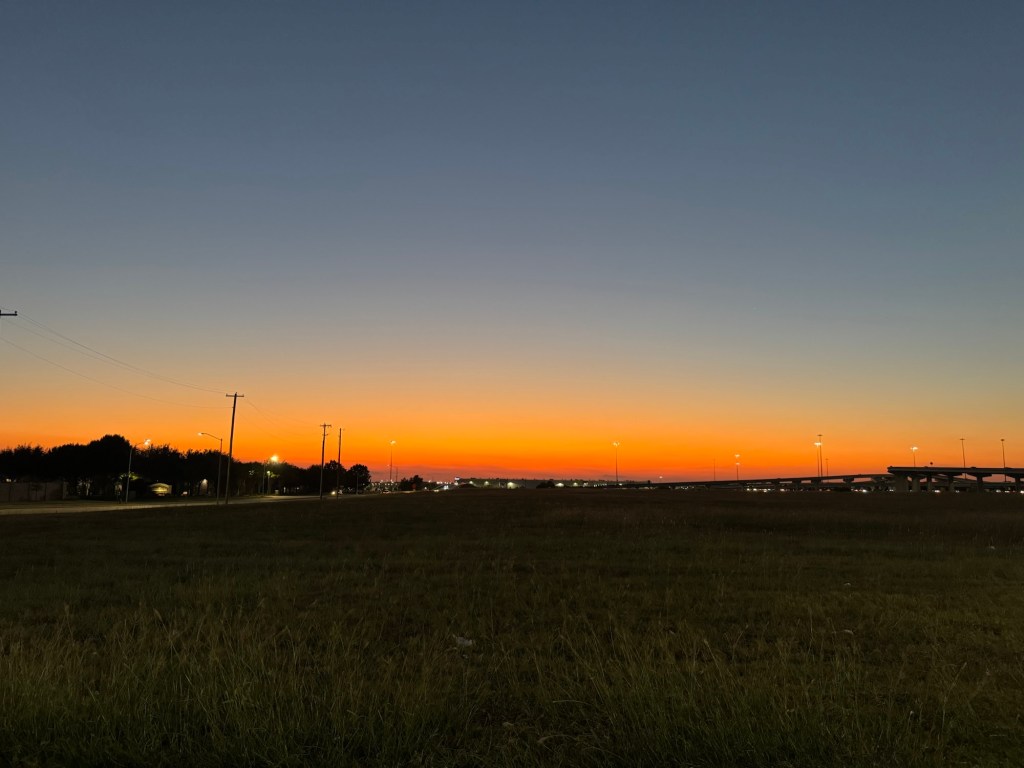
    A brilliant sunset with lots of orange shines over a big grassy field across from a suburban neighborhood, with a highway in the distance.
    Part of the field next to where I parked. Texas sky, showing off as usual.

    I was way early, arrived and parked, and ate some junk food while watching the sunset. When I was finished, I listened to a podcast and made sure my radios were ready to go. I had a problem recently with the TIDRadio where it wasn’t able to transmit, and I had reset it to factory defaults (I think it got messed up when I tried programming it with some repeaters). It seems to be working but I don’t completely trust it, so I planned on using my Baofeng.

    Then I fumbled the Baofeng, and did not realize that the A/B button got pushed. Both my radios can be set to have two frequencies to monitor, and you can push a button to quickly swap between them. When I dropped it, it swapped to a different frequency, not the one I needed it to listen to. So when it was time to turn it on and listen for the transmission, I was hearing nothing. So I grabbed the TIDRadio and turned it on, and could hear the modem-like sounds of the transmission! I had my SSTV decoder app running and it got part of the image:
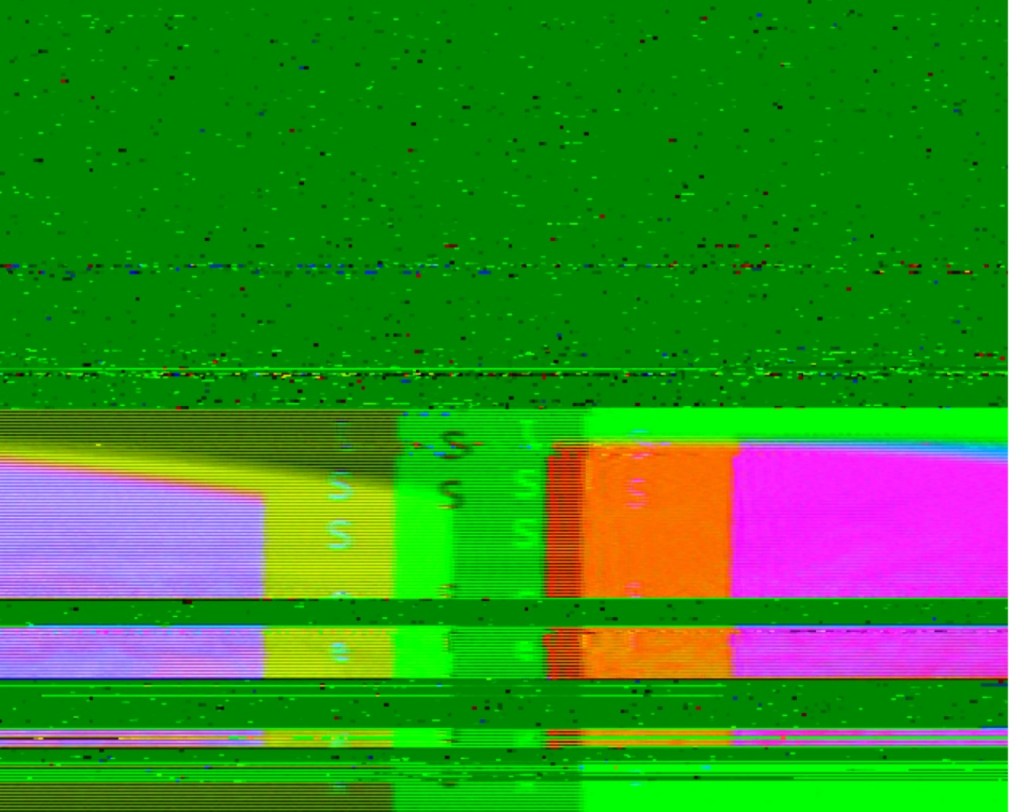
    A garbled image, mostly bright green with some magenta, red, yellow, and purple blobs at the bottom, and partial text visible with the letters ISS visible.
    Not quite right…

    As you can see, I didn’t get enough to properly decode the image, but there a more passes tomorrow where I can try again.

    Even though it technically is a failure, but I was still getting kind of excited and giddy, because I was hearing something that CAME FROM SPACE! That’s really cool!

    So tomorrow, I will be trying again, and I think the angle is good enough that it should work from home. I might as well set up my 10M radio as well and hunt POTA activators while I am at it! I will make another post soon about my HF fun, as well as update the space picture adventure results.

    For my next attempt at the IIS images, here is what I learned:

    1. I have my apps ready to go a few minutes before the pass
    2. I should double check the frequency the radio is set to!
    3. Don’t drop the radio! 😀

    Better luck to me tomorrow!

  • Visible Mending

    One thing that I think becoming a ham radio operator has encouraged me in is a desire to mend things instead of replacing them. As I mentioned in my previous post, I had to construct my own power cord for my radio. When you have to make something as seemingly basic as a power cord, then mending a rip in something seems even more basic and obvious.

    Recently, I washed the mattress cover from my bed, and noticed it ripped along a quilted line of stitching. It was a very cheap cover that I got from Ikea, and checking their site shows it’s still very inexpensive – $17.99. But it would have taken me time and effort to go get a new one, and I have plenty of thread! I grabbed a spool at the top of the box – a green one.

    Visible mending appeals to me. Instead of hiding that wear happened, why not embrace it? Show that this item of mine is actually being used, fulfilling its purpose.

    Photo of white fabric with squares of white stitches, but one portion of a line has been interrupted by green stitches holding a tear together.
    A line of green stitches runs across a white fabric.

    I sat on top of my bed, listened to a podcast, and stitched it back together. It has been a month, and my stitches still hold. It makes me feel good to sleep on something my hands did to keep from throwing away a large amount of material that many other hands elsewhere spent part of their life designing, assembling, packaging, and shipping.

    Today, I went to put away a blanket that has been sitting draped over a chair for ages. It’s a puffy blanket that I mainly use for camping, and it came with a stuff sack it can be pushed into. When I picked up the sack, I noticed that the opening flopped oddly. It had a piece of plastic sewn into the edge, and normally you fold it over and then buckle it. But the piece of plastic had snapped. If I used it as is, I was worried it would jab through the fabric and tear.

    Photo of the opening of the sack, being held up in my hand. The slat of plastic sewn into the edge has snapped in two.
    The opening of the sack, with broken plastic stiffener.

    I had been watching some videos by Laura Kampf, so was already in a re-use/repair mindset this afternoon, I guess. I thought about completely removing the fold-over closure and making it into a drawstring closure, but decided to use my stitch ripper and see if I could just remove the plastic first.

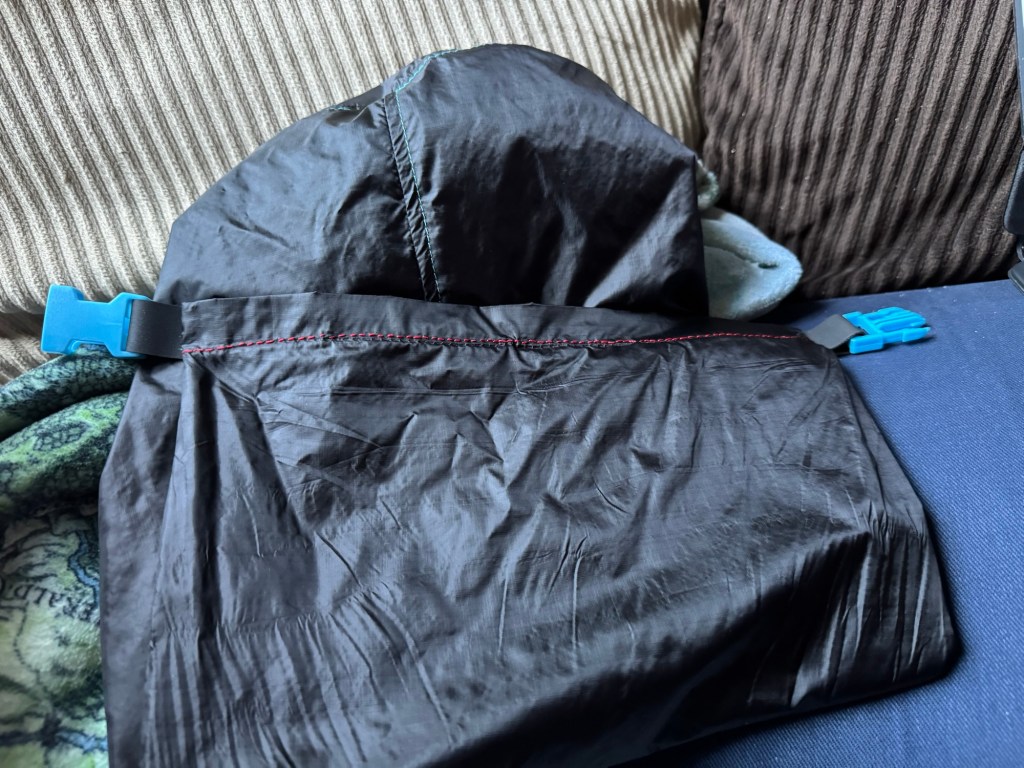
    That was successful, and so I began to re-sew the seam closed – this time with a bright red thread against the black fabric and blue accents.

    A black stuff sack with blue buckles and red stitches across the hem at the opening.

    It surprises me how quickly I can knock out a simple line of stitches. I always think hand-sewing must take forever, right? Otherwise, why would we have invented sewing machines? I wouldn’t necessarily want to make a whole garment using hand sewing, but a single line of stitches can be meditative. I sewed and let the videos be my company.

    I like this line of red stitches. It proclaims that I am here, it puts my mark on this item, it declares that it is mine.

    Photo of black stuff sack, against a pillow. The blanket has been stuffed inside, and the opening was folded down and clipped closed with the hardware sewn onto the sides.
    The sack with the blanket stuffed inside, and then rolled up and clipped closed.

    It’s not truly visible mending once it’s folded down and closed, but I know it’s there, just like I know the green stitches are there under my sheets.

    I have a pair of maroon pants that have a hole in them, and I am trying to decide just how I want to do visible mending on them, to show the world that I value my things, and want to keep them and make them even more mine. I am looking forward to it.

  • Powering through nervousness…

    Today I was determined to finally get all the parts I needed to make the power cable I need to get power from my 12V-20Ah battery to my QT80 radio. I got myself out of bed bright and early (ok, it was more like 9am) and headed out to Harbor Freight for the first time ever. They did not have the ring terminal connectors I needed, but I did end up dropping – you guessed it – fifty dollars on a new set of flush cutters to cut wire since the wire cutters I found in the toolbox in the garage were an abomination that more chewed through wire than cut cleanly, as well as a wire stripper that also works as a crimper, and a few other items as well. I also picked up a small tool bag in which to keep my radio-related tools.

    Then I went to Ace Hardware on the suggestion of the clerk who helped me at HF, but the guy that “helped” me was less than helpful and acted like I was looking for something unreasonable.

    A thunderstorm was rolling in, so I grabbed lunch and headed home to eat. I thought I was going to have to order what I needed online, and wait yet another week, but it occurred to me while having lunch that maybe an auto parts store would have the connectors, so I hopped back in the car after the storm was over and was successful in my quest!

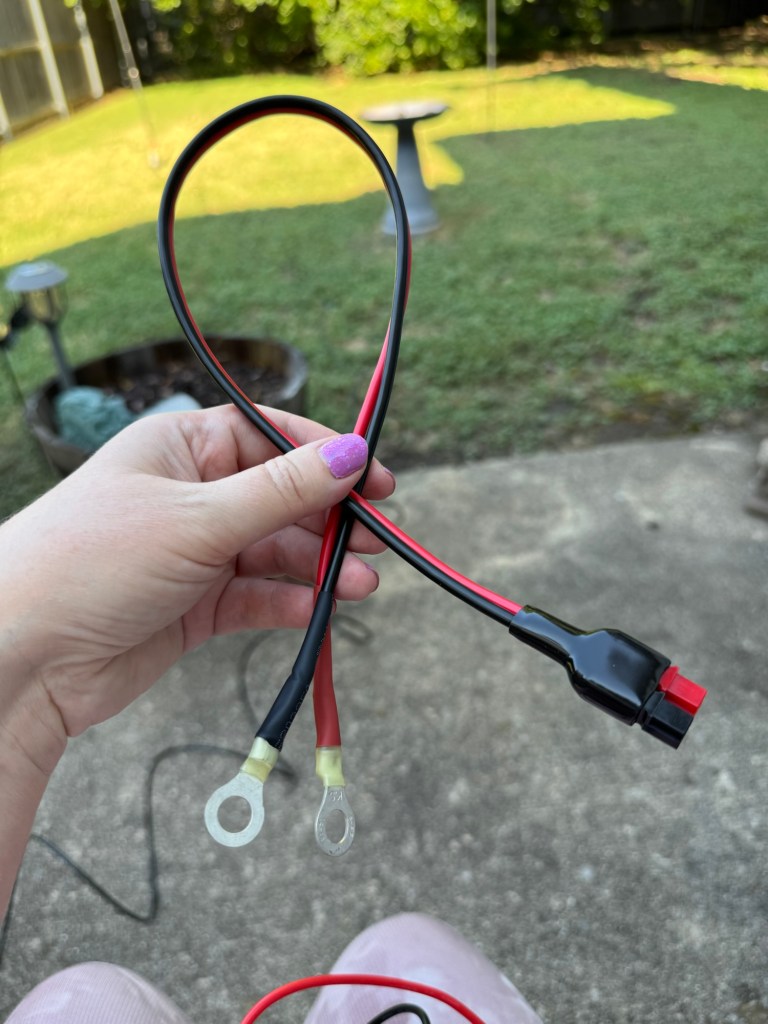
    I got home and was able to create the cable I needed to connect the battery to the radio:

    A photograph of a cord in my hand. One end of the cable has two ring terminals and the other has a set of Anderson Powerpole connectors.
    Handmade power cable

    After I made the cable, I used my multimeter to make sure the cable had conductivity through it on both sides.

    I also re-did the Powerpole connectors I added to the end of the radio’s power cable because after making the battery cable, I knew I had not secured those sufficiently. After doing all that, I was finally ready to plug in my radio!

    And it WORKED!

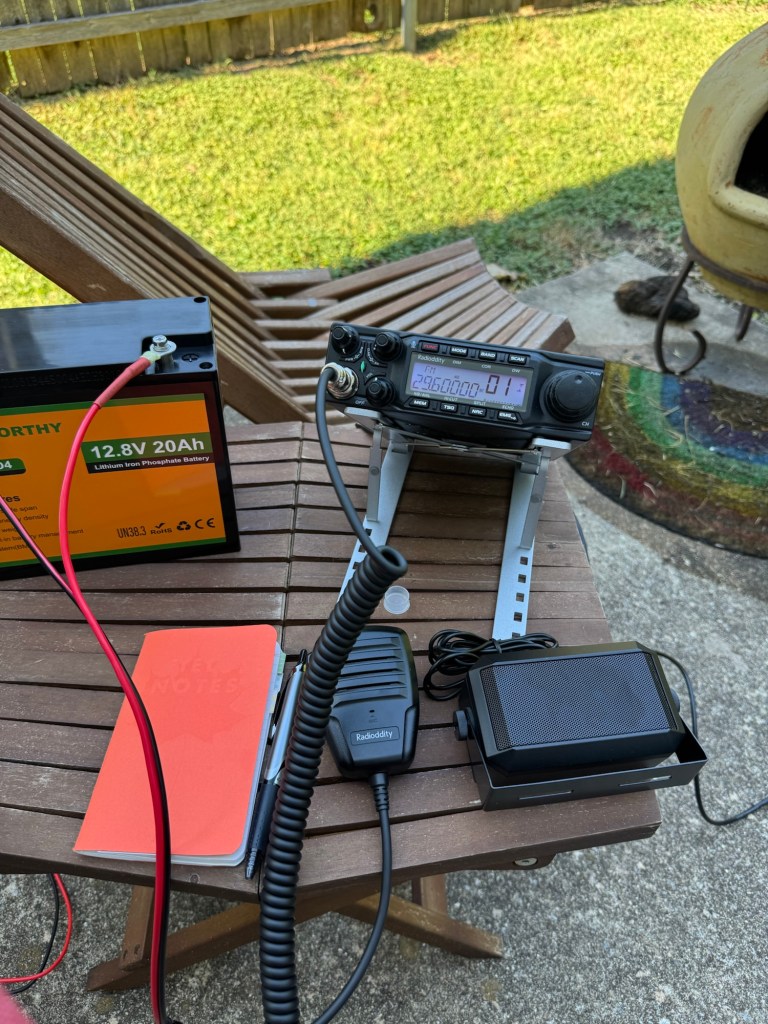
    I had power to the radio, it turned on!

    I was very nervous that I had done something wrong somehow, and the battery was going to catch on fire, but it did not, and it didn’t seem to be heating up or anything.

    I fiddled with the radio a bit but soon realized that I need to sit down and flip through the manual and maybe re-watch the QT80 videos to get a feel for how to operate the radio. I could move through the band a bit, but not with confidence, and I only caught a voice twice, without a good signal.

    I need to watch some videos on how to use the NanoVNA to set up my antenna at the right lengths for the bands I can receive on this radio, and on my (tr)uSDX, which also needs to have a way to power it that’s a little more beefy than USB phone bank power.

    I have a battery case and some 18650 batteries on their way to make a nice portable setup for that radio… and you will never guess how much that cost! Yes, that was sarcasm. It was right around $50, of course.

    Getting the power cable made was a nice little confidence booster, proving to myself that I did comprehend what I had researched, and that I am not going to set myself on fire or electrocute myself, or damage my equipment. At least, not so far!

    My goal this week: figure out how to make the radio “hear” more than faint sound! Fingers crossed!

  • Always About $50 Away From Getting On the Air…

    I was hoping to set up my new radio… no, not the (tr)uSDX, I got a Radioddity QT80 so I can do voice on 10 meters… anyway, I thought “This weekend I will be able to spend the day getting on the air on my own!”

    But it seems like there is always one more detail that I need to take care of before I can actually do it.

    You see, the (tr)uSDX is tiny and cool, but it transmits on 80, 60,40, 30, and 20 meters. None of which I am allowed to transmit on using voice (called “phone” in ham-speak) as a Technician. I can transmit on 80 and 40 using CW (Morse code) but I don’t have the skill in CW to do that yet. Also, I am having an issue getting it flashed to the latest firmware that I have to figure out.

    So I ordered the QT80, which does 10M by default, of which I am allowed to use voice on a small sliver. It also can be unlocked to allow the use of 15 and 12 meters for ham radio (which I cannot talk on as a tech and can only use CW on part of 15), as well as the 11M CB band. It arrived in the mail Friday. Hurrah! Except…

    Ham radios don’t really come with a power cord you can plug into the wall. You see, we are expected to decide how we want to power our radios and add the connectors ourselves. It comes with cords that just have bare wires sticking out of the ends.

    I knew this, but I didn’t really know this until I unboxed my new toy and realized, “oh yeah. I should have ordered the bits to stick on…”

    But you still don’t really just solder on a wall plug. The QT80 is a portable radio, meant to either be installed in a car or taken around with you. Which IS what I want to do with it. So it needs ends that connect to a DC power source like a battery.

    Great, I have portable power stations! That will work, right?! Not exactly.

    Most hams I have watched on YouTube encourage the use of connectors called a powerpole (originally Anderson Powerpole) that allow DC connections. My portable power stations don’t have powerpole connectors. I would need to either buy or make a cord that has powerpole connectors on one end and a 12V cigarette lighter-style plug on the other, which my power stations will accept. I don’t want to stick a 12V connector directly on the power cord from the radio, because that will limit my options to only be able to use that kind of socket.

    So I need powerpoles and a way to put them on the wires… I ordered a set with a crimper and the connectors. That was about $35.

    That still leaves how to get from those connectors to something that sends power to it. I most likely will have to solder to make a cord. Or I could buy one for around $15-20.

    But I have heard mention about power stations being “noisy” – creating electrical interference, which is not good for radios. And my stations are pretty bulky. There are smaller Lithium-Iron-Phosphate batteries that will work well for portable radio. Great! I ordered one. $50!

    Then it arrived, and I realized – oh, I don’t have a way to charge that battery! I need something to put energy in that battery so it can put energy in my radio. So I ordered a charger for it for another $50.

    I am always $50 away from being able to get on the air.

    Later I will figure out how to get energy from my solar panels into the battery, but right now, I just want to get on the air!

  • Making machines go SKREEEE

    In order to get on the air, I need (besides getting my license) a radio. But I also need an antenna. I would like to eventually make my own antennas (and radios!) but first I just wanted something that would get me on the air for a taste of receiving and transmitting.

    My first antenna is a 17” telescoping whip. Picture a portable radio in your head, and its metal antenna that pulls up, then make it WAY bigger. That is basically what I have.

    The antenna screws into one side of the base pictured below, and a spike screws into the other side of it to stick it into the ground, and a coax cable goes from the side to my radio. There was just one problem…

    Some of these cheap antenna sets has a little metal tab to show which end to screw the spike into, because the threads on both ends look exactly the same. The one I received is missing that.

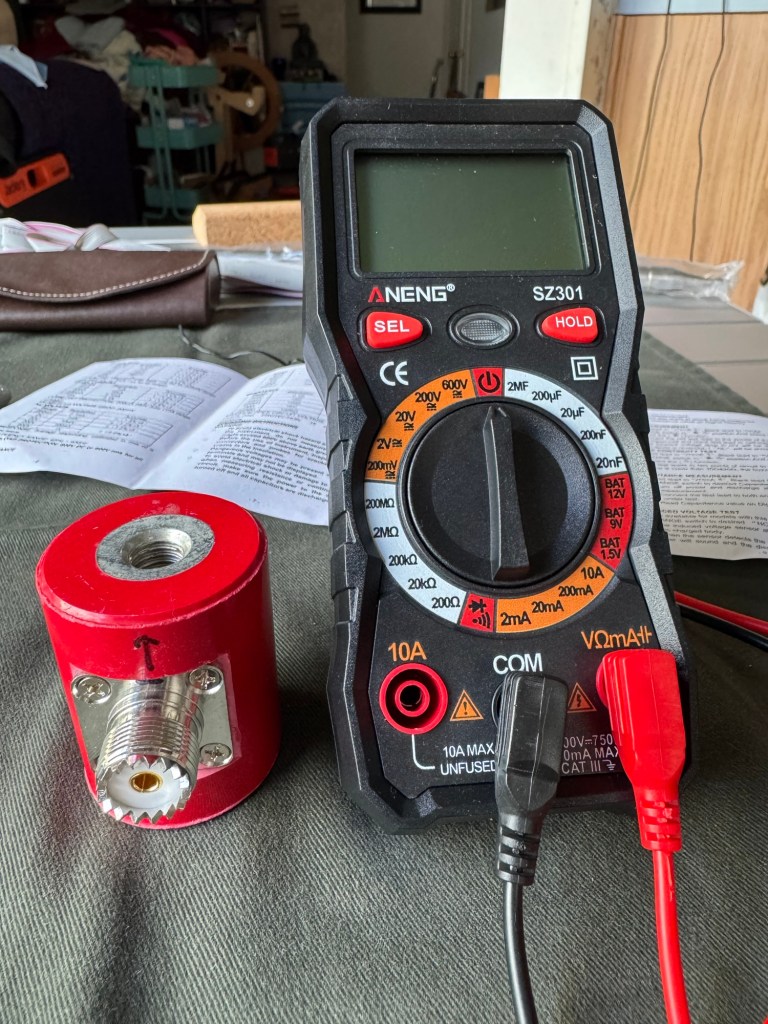
    In order to determine which end actually gets the little air slinkies to come in and slide down the cable to my radio, I had to learn to use another new toy: a multimeter.

    As indicated by the MULTI part of multimeter, it does multiple things – you can see if current is live on an outlet or if a circuit is intact & will allow electricity through, and things that I don’t have the skills to explain yet. In this case I needed to do a continuity test to determine the end that would allow the signal to go from the antenna to the cable.

    Thanks to the internet and specifically this video, I was able to easily figure it out:

    Multimeter Basics on YouTube

    Now, I could have put everything together and then tried to tune in a station on the radio, then taken it apart and tried it the other way if it didn’t work, but this was quicker and easier to do inside in the comfort of air conditioning! I am glad that I knew I would need a multimeter and had already ordered one.

    Basically you plug in the leads, turn the knob to the little wi-fi-looking symbol (it’s not though, I think it means it plays a sound) and then touch the leads to the center post where the coax gets connected and then touch the inside of the ends. It makes a SKREEE sound when continuity is detected.

    Once I had performed the test, I used a Sharpie marker to put a “this end up!” arrow in it. I might add another in case that rubs off.

    Then I went out into my backyard and verified that my radio could in fact pull voices from the ether. I can’t wait to be able to play with it more seriously this weekend!

    The neat thing about this antenna is that you can extend it all the way out to make it get one band and then shorten it by collapsing sections to get others. I will have to learn to use a second tool I got – the NanoVNA, which I will use as what’s called an antenna analyzer- to figure out what lengths work with which bands. It’s very versatile!

    Next post I will introduce my radio… or rather, radios, because I did end up ordering a second radio already, that covers a band my first radio does not. More on that later.

  • Sea Monkey Keeping

    One of the things I have been enjoying this year is keeping Sea Monkeys – remember those comic book ads? They are still around, and have competition, even!

    If you follow me on Bluesky, you will have seen my posts for #SeaMonkeySunday – I figured if cats can have Caturday, pet brine shrimp can have a day as well.

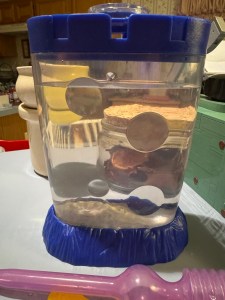
    I set up my first tank in late March, a very old school Sea Monkeys “Magiquarium” with a glow in the dark tank bottom.

    A sea monkey tank with a blue lid and base, with a molded, glow-in-the-dark interior base that looks like a low volcano caldera.
    Sea Monkey tank

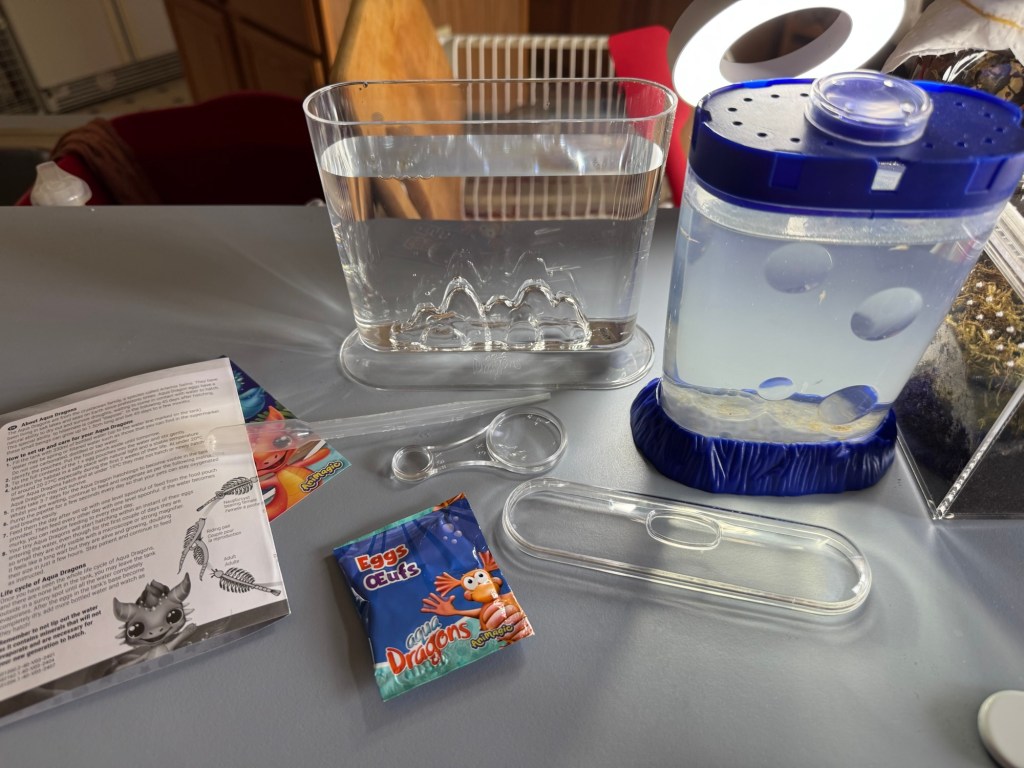
    The next month I added a different brand, the Aqua Dragons. I really like the design of their tank, it’s very sleek and unobtrusive to viewing.

    The clear plastic Aqua Dragons tank sits on a counter next to the Sea Monkeys tank. It is slightly shorter and thinner, but wider. It has a molded plastic mountain range at the bottom. In front of it is the lid, an accessory magnifying glass that came with it, the packet of eggs and salt, and the papers explaining care.
    Setting up the Aqua Dragons tank.

    It has been really fascinating watching these tiny crustraceans develop. In a couple of days my Sea Monkeys tank will be 4 months old. I am down to only three individuals left.

    Sadly, on Tuesday the last remaining Aqua Dragons died, so I have only the Sea Monkeys left.

    I spent entirely too much time making a memorial video for the Aqua Dragons, which I share with you now:

    RIP Aqua Dragons

    They are, in theory, the exact same species of brine shrimp, so I do not know why they lasted only 3 months while the Sea Monkeys are still going at 4 months with 3 individuals. They sat side by side the whole time.

    I have another Sea Monkeys tank kit waiting in the wings should these ones go to the big tank in the sky. These little critters are surprisingly interesting, and my interest in these crustaceans expanded to isopods and keeping those, which means I also have springtails. I will detail more about them later though.

    They are a very low stakes pet to keep, and pretty easy once they are hatched, so I encourage anyone to set up a tank. They are fun and make me happy every time I peer into the tank.

  • My first Ham Radio Contacts!

    In April I took a class for learning about Amateur Radio (aka Ham radio), and in June I took my Technician test & got my license. Just call me KJ5LWM. That is my callsign- that’s kind of analogous to a username or handle on an online platform.

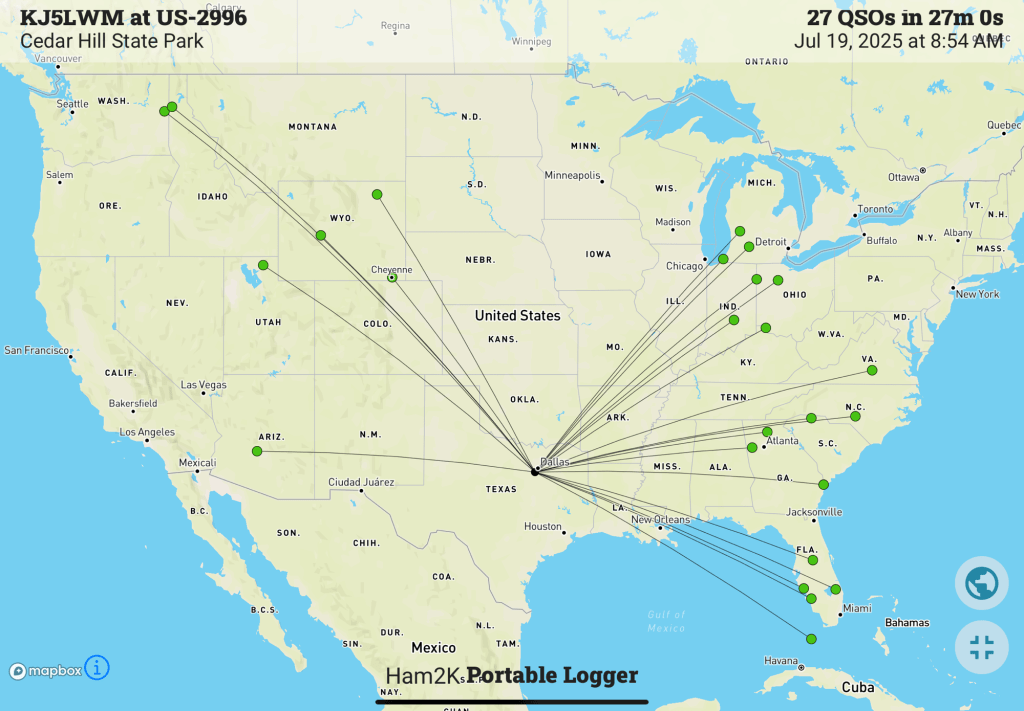
    Saturday, the 19th of July, I went to my local state park and a local club helped me to get on the air since I do not have all the equipment I need to do it on my own yet. I made 27 contacts. That’s the term for talking with another amateur radio operator and trading information. There’s a site called Parks on the Air that allows you to track making connections to people in parks and the people trying to find them on the air. I was one of the people in the park today.

    Here’s a map showing where the people I talked to were contacting me from:

    The dot in Texas was me, of course, and the lines going to dots all around the country were the people I talked with.

    I am having fun learning about amateur radio and how to make things work, and am impatiently waiting on an antenna I ordered to arrive so I can make sure things work (and HOW things should work!) before I start building my own radios and antennas.

    Expect some entries here on things I am trying out and experimenting with, more to come soon!

  • Holy Grayl? Not quite…

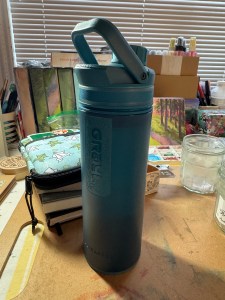
    I have had the Grayl Ultrapress for two years now. I haven’t thought I really needed to use it, because the places I have hiked & camped have had portable water spigots and fountains at their trailheads and sites. I used it intermittently anyway so that I could become familiar with it for the times when I would actually need it.

    A blue water bottle with a spout and handle, with the words Grayl down the side and Ultrapress at the bottom. It is translucent plastic with a rubberized cap and ring around the bottom for traction.
    A blue Grayl Ultrapress sits on my kitchen table among my art supplies.

    With all of the news stories lately about PFAS in drinking water, I decided to use it even at home, as news reports have mentioned that it’s in water supplies in many places – including my area in general (though my particular municipal water system claims it does not have PFAS). Grayl’s website states it will filter PFAS.

    Pros:

    • Filters AND purifies water (most other products only filter) including PFAS.
    • Not an attention grabber – it looks like any regular water bottle.
    • Simple to use (that isn’t necessarily the same as easy to use)
    • Can pour filtered water into another container easily

    Cons:

    • Requires user to be able to stand on a solid surface and use their upper body weight to filter (difficult for wheelchair users and folks on small watercraft)
    • If a larger amount of water is needed (for cooking, sharing with others, etc) you have to repeat the process multiple times, which expends more energy than other methods of filtering
    • Expensive
    • Filter cartridge unit cannot be back flushed/cleaned to extend its life
    • Does not fit in my car’s cup holders

    It did not take me long to get tired of the small amounts of water (16.9 oz) I can get from the bottle, and I ended up getting a 2 gallon carbon filter for home use, which has worked well.

    It was a valuable experiment, since it made me realize that although my tap water seems fine to me taste wise, it has actually made a positive difference in how my tea tastes.

    I do sometimes take it with me when I leave the house so that I can filter on the go without attracting a lot of attention, though I tend to prefer to bring 2 large Nalgene bottles with me that hold what I need until I return home, especially when I go hiking. For larger amounts of water filtering, I have a Sawyer Squeeze Mini in my gear, which I can backflush to clean.

    I have tossed the Grayl into my car emergency bag, so it is there if I need it, but it’s not going to be in rotation to be regularly used.

  • Social Media Accounts

    I have been trying out Bluesky since July, and other than missing the news organizations & weather accounts that are not over there yet, I gotta say I really like it. If you have an account, you can find me there using this domain as my handle.

    I am still on Instagram as well, and I’m trying to decide if I should repost my photos that go there here as well, or use Insta as a portal to get people to come here to see more info about what I post there. My handle there is skulleigh.

    I still have my account at the old bird site, I figured if I deleted it, some bot would swoop in to reuse it for profit if possible, so I’m hanging on to it as long as I can before that place implodes, but I am not posting anything of substance there, just enough that the account doesn’t get declared inactive.

    I have deleted the Twitter/X account and deactivated Instagram.

    I really hope this whole shakeup of social media platforms gets everyone to pivot back to having their own geocities-type sites and we can all go back to using RSS feeds or something 😀

  • I’m 3% Neanderthal

    What historical event fascinates you the most?

    It’s not really a single event that fascinates me – it’s an arc of history: the development of Neanderthals and their incorporation into the modern human gene pool. I want to know how alike they were to us, how they were different, and what tools they developed and used, how they lived.

    Years ago I got a DNA profile done from 23 and Me, something I would probably choose not to do today, but the entire reason I did it was to find out if I have Neanderthal DNA. And I do!

    So I want to know about my Neanderthal ancestors and their dreams and intellectual capabilities.

    We have gone from seeing them as hunched grotesques to something more nuanced, and I am so curious what the real stories are.