Author: skulleigh

  • Tornado Watch vs Warning

    Awhile back I had someone who recently moved to Texas from a place that doesn’t really get tornados express that they were confused between Tornado Watches versus Tornado Warnings, so I created a thread on Twitter with a bit of an explainer & what to do when you are under a Watch or a Warning. With a little polishing, here is that explanation all on one page!

    A tornado watch means that conditions are right for the possibility that tornados will develop. It’s TIME for you to keep a WATCHFUL eye & do what you can to prepare, just in case. All the ingredients are present for a tornado, they just haven’t combined in a way that makes them.

    A tornado WARNING means that either:

    • a person (that can be a member of the public, storm spotters, or a law enforcement officer) has visually seen a tornado & reported it
    • a funnel cloud (basically a tornado that is just coming out of a cloud bottom & hasn’t reached ground – it may or may not ever touch ground) has been reported
    • strong rotation is seen on weather radar
    • or a water spout (essentially a tornado over water) is heading for land.

    Lots of folks say images like this help them remember which is which!
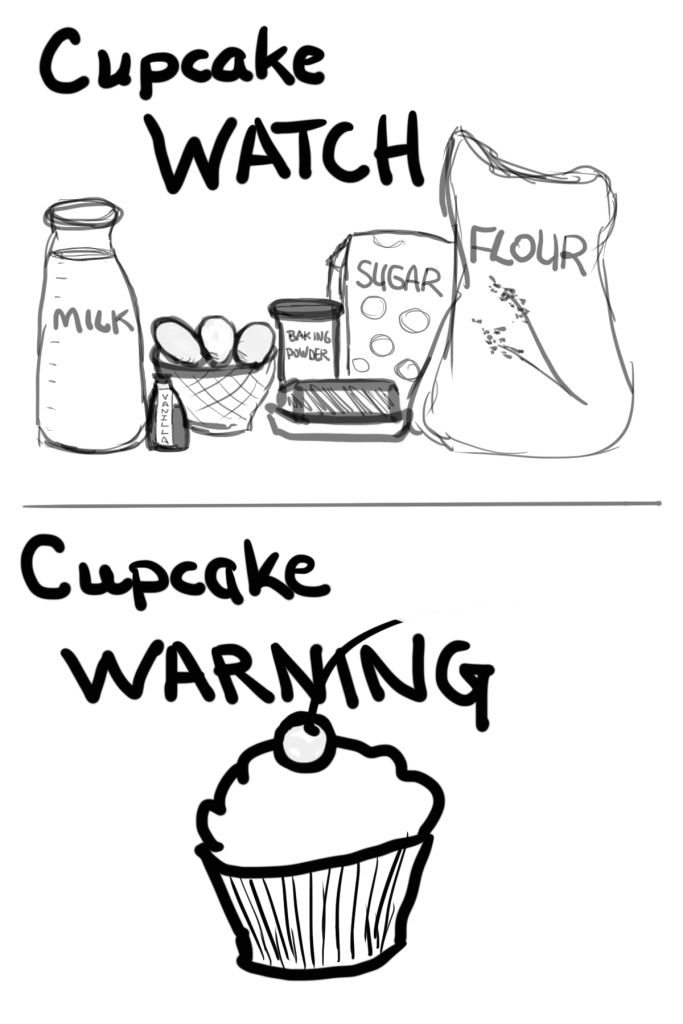
    Cupcake watch: shows the ingredients that go into making cupcakes
    Cupcake warning: shows a cupcake

    So what should you do if your weather person says you are under a tornado watch?

    The first thing I usually do, is either put on a pair of sturdy shoes or make sure I know where they are and put them in a place where I can easily grab them in case I need them. You do NOT want to be barefoot in a debris field, especially if you can’t remember the date of your last tetanus shot.

    Plug in your cell phone to charge the battery if it’s not full. Your phone is an important tool you can use to get information and communicate with others.

    Know where your people are! And pets! If you have kids at home, get them in the house, and get their shoes on or know where they are. Get your pets inside, and if they tend to be scared of bad weather, it may be best to crate them/put them in a carrier now. You don’t want to have to drag a frightened animal out of a hiding place, or try to handle it when it is trying to get to a hiding place.

    Decide where the best place to shelter in your house is NOW while you have time to think it over. Ideally, you want a windowless room on the ground floor, in the interior of the house, as close to the center as possible. Put as many walls between you and the outside of the house as possible. If you have a basement, that’s even better, provided that floods are not a danger.

    I have a closet under the stairs, & it is probably the best place in my house. All my bathrooms are near the outside edges of my house or on the second story. But I do use my guest half bath when there’s less warning since I don’t have to pull stuff out of it go get inside.

    Bathrooms are favored if they are on the ground floor, have no windows, & are near the center of the house. Plus the bathtub makes a good place to duck & cover for protection.

    If you have a bike helmet (motor or pedal) or other noggin protecting headgear, it can give an extra bit of help as well, so getting it handy is useful. If a tornado is coming, put it on!

    If you have a battery powered radio, get it and make sure the batteries are fresh. Set it in or near your chosen shelter. If you don’t have one, I HIGHLY recommend getting a weather radio that can use batteries or run by hand crank.

    If the electricity goes out, you don’t want to be in the dark literally AND figuratively without an idea of how long the storm is going to hang around. Have a flashlight or lantern handy and make sure it is working and you have fresh batteries available. Ask me how I know… embarrassed laugh

    If you have a Go Bag, make sure it’s handy as well. See this post for how to start yours.

    That’s pretty much it for a Watch. Just continue to monitor your choice of weather persons/station to keep an eye on things.

    If you are not at home when a Watch is issued, it might be a good idea to head there if you can make it before the storm arrives. You don’t want to be caught outside or be in a car during a tornado. That’s… not good. You will have a bad day. If you cannot head home, look for a place you can take shelter if needed.

    If you live in a mobile home/trailer/RV, you need to decide ahead of time where to go in case of a Warning, before you are in an emergency. You need to go to a building with a foundation or a purpose-built tornado shelter. Even if your trailer is tied/anchored, it’s not safe. See https://youtu.be/HeOsOxecOaw for more information. Please know, this isn’t me hating on mobile homes, BTW. I lived in mobile homes for about half my first 23 years. They can be fine homes, but they are NOT safe in severe weather.

    Ok, so you’re prepared, you’re keeping an eye on the sky. You are watching. Now, what if a Warning is issued? First, figure out if the tornado is heading your way or not. Listen or Watch your local weather reporting so you know! Either television or radio.

    Does your area have an emergency siren system? Do you know what a siren sounds like? Here’s an example: https://youtu.be/WXsTHg_DiYA

    Be aware that emergency sirens are not designed to be heard from within a building although they sometimes can! That’s why it’s important to have some device or devices that you can receive emergency alerts on, such as a weather radio or your cell phone.

    While they are commonly called “tornado sirens” they are also sounded in my town and in towns around me in the event of:

    • hail bigger than 1.75 inches
    • winds in excess of 70mph
    • chemical spills
    • other state/national emergencies

    That’s why your crank/battery radio is so important! You need to know exactly WHAT emergency that siren is warning you of.

    Sirens are tested on a regular schedule providing the weather is good. They don’t test unless it’s clear, & they always test at the same time & the same day each month.

    If a Warning is issued and a tornado is heading your way, get you & your family into your place of shelter, put on your shoes if you haven’t already, and hold on.

    I’ve always heard it’s a good idea to get in the tub & pull a mattress from the bed over you, & I’ve heard people talk about how they did it before. But usually, it’s a twin or a crib mattress. I don’t think I could hoist anything bigger than that & wrangle it into place in the time you have to seek shelter. If I think ahead I do grab the pillows off my bed, but that king size ain’t going in a closet under the stairs.

    Keep listening to your radio, so you know when it’s clear & safe to come out. But if the tornado is actually near you, you probably can hear it & nothing else till it’s gone anyway.

    Folks often say tornadoes sound like a freight train. I’ve been through a couple & it’s never sounded like that to me, but I have weird ears. Here’s an example of what a tornado sounds like:
    https://www.youtube.com/watch?v=zE8oOfWocVc&t=1s

    It always sounds more like lots & lots of wind to me, and some whistling sound. https://youtu.be/3Qu9wR03GVA

    BTW: The people filming those videos are storm chasers, not regular humans. DO NOT do the FOOL ASS THING they are doing. They have special dispensation from the trickster gods to be fool ass fools, and bless them for it. They are useful fools who do a great service.

    If you make it through mostly intact, keep the fam & pets indoors for now. Take a peek outside & look for downed power lines. DO NOT APPROACH THEM and FFS don’t touch them if they are. Call your local services & report.

    Watch for debris on the ground & walk carefully. Don’t go in any collapsed buildings unless you need to rescue someone, in which case I didn’t tell you to do that & you should really call emergency services. But where you safely can, please help your neighbors.

    Don’t go feckin’ sightseeing in neighborhoods that get hit. Don’t get in the way with your damn rubbernecking. Just don’t do it.

    Tornadoes can be really scary, but the more you know, the more it helps. Don’t make fun of your kids for being scared, ok. Smol Skulleigh was terrified of tornadoes & the jeers Did Not Help. What helped was knowledge!

    This is an excellent FAQ for more info: https://spc.noaa.gov/faq/tornado/index.html

    Ok, gonna wrap this up – I hope this was helpful & if you have any questions I will do my best!

    PS: Yes, I do unironically love the movie Twister. No, I’ve never watched all of Sharknado.

  • Black Worm Tea Society

    Black Worm Tea Society

    Awhile back, I fell down a slight rabbit hole as I was having a Gong Fu tea brewing session and browsing YouTube. I happened to see a suggestion for a video about fake martial arts. It showed an old comic book ad for a scammy Kung Fu martial arts society. Gong Fu is actually the same word as Kung Fu, just an alternate westernized spelling. My brain, being what it is, leaped to starting a scammy tea society, and I created a joke version of the ad.

    Fake “Black Worm Tea Society” comic book ad

    A friend then threatened to actually send a self-addressed stamped envelope for the “membership kit” and well… I ended up making a membership card and started creating a “World’s Deadliest Pouring Secrets” booklet/zine.

    Fast forward to today, when the friend’s SASE actually arrived, and well… I had to finish creating the zine.

    The only way to become a card-carrying member is to already know what address to send the SASE to, but you can get the World’s Deadliest Pouring Secrets right here… if you dare!

  • You should have a go-bag

    You should have a go-bag

    Storm clouds building in the Texas sky

    I live in Texas, where the sky regularly tries to kill us. If it’s not thunderstorms, it’s hail, and if it’s not that, it’s tornados. Folks to the south have hurricanes, and to the west and southwest have wildfires to contend with as well. Disasters can cause homes to be uninhabitable until repairs can be made.

    A few months into the pandemic, in 2020, I had to evacuate my house and neighborhood for about half a day because a natural gas line caught on fire and there was a danger of explosion. In 2021 Texas experienced a winter storm that caused power outages – some for multiple days – across the state during very cold weather, and I again had to leave and go to stay with friends so I didn’t freeze. I’ve also had extended power outages during the height of summer, in over-100 degrees Fahrenheit weather.

    Thankfully I already had a prepared go-bag and a charged-up power station, so I was able to quickly grab what I needed and get out of the house.

    What is a go-bag, you might ask? It’s basically a kit that you can grab and leave your house quickly in an emergency, and it contains basic supplies that you will need in a disaster if you are required to leave your home.

    You can find a checklist at Ready.gov that outlines everything they recommend, but I find that some people feel that list is intimidating, or it sounds expensive – and it can be if you are building it all from scratch and buying things specifically for it, and if you are creating a kit for multiple people such as your family for several days as they recommend.

    What I suggest is starting with enough for a one-day evacuation with things you may already have. The majority of the times I’ve had to bug out of my house I’ve only had to be gone for a half or single day. Once you have your go-bag set up, you can gradually add to it as time goes by to make it useful for a longer period of time.

    Grab a bag of some sort. This doesn’t have to be fancy, you probably have a freebie canvas or cloth bag that you got from somewhere or one with art you once loved printed on it, but that you aren’t actively using stuffed in a closet somewhere. I just walked into my clothes closet and found three without even trying! Don’t worry if it doesn’t zip or snap at the top, but if it does, that’s a bonus!

    Now you’re going to start adding things to your bag. I tend to think about the things that go in as modules or groupings of items, and if you can put those things in smaller bags inside the bigger bag, you’ll make your life easier, especially if your outer bag doesn’t have a way to close it. You can use zip pouches, ziplock bags, or even tie things up in a spare bandana or scarf (which itself can be handy in an emergency, as a sling, a filter, a hot or cold compress, or a head covering).

    Here are the modules/categories I tend to group things into:

    • Clothing
    • Personal care
    • First aid
    • Power & Tech
    • Documents
    • Food & water
    • Entertainment

    You may be able to combine some of these groupings – such as personal care and first aid, or tucking documents into your power & tech module. Use your best judgment.

    Clothing: Is there an outfit that you don’t wear much but still fits? Stick it in there. At the very least, put in a change of underwear & socks. After a stressful day, it can really make you feel better to have warm feet. I really do recommend putting the underwear and socks in a zip bag to keep them clean and dry. No one wants to put on damp undies.

    Personal Care: Grab a roll of TP – it doesn’t even have to be a full roll, to save space you can grab a roll that’s halfway used from your bathroom. To further save space, squash the roll flat. I highly recommend popping it in its own ziplock bag to keep it dry. If you need/use them, put in tampons or pads, enough for a day, at the least. If you have spare travel-sized toiletries, like hotels provide, you can add those, or pick some up from a store. Add in a toothbrush and toothpaste. If you can, a packet of baby wipes will provide you a way to get at least slightly clean if you don’t have access to a shower or bath.

    First Aid: bandaids, burn ointment, antibacterial ointment, a small container of your preferred painkiller (it’s a good idea to note the expiration date), and any daily medications you require. You can purchase small first aid kits that you can add your own medications to, but don’t forget to rotate the ointments/creams out when they expire!

    Power & Tech: If you have a spare charging cable & power brick for your phone or other electronic devices it’s a good idea to have it in your go-bag, so you don’t have to remember where your usual one is while stressed or have to crawl under or behind furniture to unplug it when you’re trying to get going quickly. A power bank for recharging your phone or other devices is also a good thing to have in case you can’t find a place to plug in. This module is also a good place for a USB thumb drive with any important data you may need as a backup – that can be a list of addresses and phone numbers of family and friends, a password protected list of your own account numbers and passwords, or whatever data is valuable to you. This is also a good place to add in a small flashlight or headlamp, and batteries for it.

    Documents: I highly recommend this bag also being a waterproof one, and you can add in things like your passport, copies of medical or eyeglass prescriptions, copies of your insurance policies, or other important papers you might need if you end up having to be away from home for an extended period. I also tend to tuck in a little cash or gift cards for chain stores that tend to be widespread, like Target or Wal-mart so you can pick up items that you might have forgotten.

    Food & Water: It is recommended that you have enough water for each person in your group to have 1 gallon per day. That can be very bulky and heavy, especially if you do not have your own method of transportation. I recommend that you at least have a sturdy 1-liter water container already filled and possibly later add a filter such as a Sawyer or LifeStraw. You probably have a water bottle that you have been given that you can use. For food, some sort of snack that you commonly already eat & keep in your pantry is a good idea so that you can keep it rotated out and not worry about it being expired. Things like granola bars, packets of tuna salad and crackers, peanut butter, and such things are good. Some people recommend MREs (Meals Ready to Eat – military meals intended for soldiers on the march) and dehydrated hiker meals, but they are generally high in salt and if you’re not used to them, can be unappealing and difficult to prepare in a stressful situation. If you are willing to add in some method of heating water, such as a backpacker’s stove, you can add in things like instant oatmeal, ramen, and hot drinks like tea, instant coffee, or instant cocoa. A hot meal or drink can make you feel human again!

    Entertainment: Most emergencies that result in your needing to leave your home involve a whole lot of waiting around to be able to return. It’s good to have something to do during that time. This is a small module that can make a big difference. It can be as simple as a deck of cards to play solitaire on your own or go fish or even poker with your family or friends. It could be a small sketchpad and pencils for drawing or playing tic-tac-toe or hangman. You might tuck in a paperback copy of your favorite book. Give yourself something to do besides worry and pace!

    Now you have the basics of a go-bag put together, and you can expand it to multiple days as you wish, and start customizing it for what you actually need. Create your own checklist based on the above info, and based on the recommendations at Ready.gov, and keep it with your go-bag so you can replace things as needed. Congratulations – now you’re prepared!

  • Kanzashi-A-Long

    If you’re a space gnome (and you will know if you are) then you might be doing a Kanzashi-A-Long with me on Saturday.

    Kanzashi is a short name used in the west for what’s technically called Hana Tsumami Kanzashi. They are the flowers folded from silk fabric that are often used on hair decorations that are *actually* called Kanzashi. Kanzashi are made out of different materials/in different forms, and Hana Tsumami Kanzashi is just one form.

    A beautiful purple Hana Tsumami Kanzashi I purchased last year in Tokyo, and a small single flower on a barrette I made quite a few years ago.

    What are you going to need to make Kanzashi flowers? Here is a supplies list of things that might be in your house right now, since you’re staying home, right? There are a couple methods that you can use depending on what you have.

    Supplies

    If you have fabric:
    – Fabric – quilting cotton or if you’re brave, silk (on the heavier side is probably better)
    – Needle & thread OR Aileen’s tacky glue OR fabric glue
    – Scissors OR a rotary cutter
    – A ruler or quilting square
    – An iron

    If you have wide satin ribbon:
    – Wide Satin Ribbon – preferably polyester rather than natural fabric
    – Scissors
    – A lighter AND/OR a tea candle (you’ll melt the ribbon instead of gluing or sewing

    If your fabric is made of a polyester material, you might be able to melt it as well (one of the videos linked below shows this). PLEASE be careful. This is not the time for injuries!

    The next set of items are good for either method, and you can improvise as you wish, depending on the supplies you have

    Buttons, gems, or beads to decorate the centers of the flowers
    Pin backs, barrettes, bobby pins, combs, or other findings to which you can affix the finished flowers
    Hot glue gun
    Pointy tweezers

    Resources:

    I learned to make the yellow flower above from a tutorial by Diane Gilleland, and she subsequently published a book called Kanzashi In Bloom with instructions on how to make them. I have the book and that’s mostly what I’ll be working from. It’s available as a Kindle eBook and in the Apple Books bookstore as well, currently $9.99.

    There are a LOT of YouTube videos on how to fold as well. Many of them focus on using ribbon, which I don’t have a lot of. So you’re on your own, gnome! But these videos looked useful:

    If you decide you like making these, once nice thing is it’s a hobby that doesn’t take up much room and is extremely portable… you know, for when we can go places. Heh. Anyway…

    If you precut squares of fabric or ribbon, you can tuck them and your other supplies in a little zipper pouch and go someplace else with them. Like the other room. Or the couch, or the bed. Or the back porch! Anywhere, as long as right now, you are staying home as much as you can!

    If we can’t go to the flowers, let’s make some!

    See you, space gnomes!

  • A zine for the season

    For spring! I have created a zine that you can print out and fold yourself then read to learn how to draw a simple labyrinth. It’s in PDF format, and is in color, but you can print in black and white if you prefer, and it is still legible.

    A small preview:

    To assemble, fold in half and crease, then unfold. Do this in both directions. Then, holding it horizontally, fold the ends to the middle and crease. Unfold.

    Using a blade, and a ruler if you prefer, slice the middle horizontally along the fold. Slice between the middle 4 “pages” – do not slice all the way – leave the ends uncut.

    Then fold lengthwise with the unprinted sides together. Push the middle pages outwards and crease. Fold with the covers (which are in the upper left in the image above) on the outside.

    If you need a little visual assistance, this video might help:

    And you might even want to make your own!

    But don’t forget to download the How to Draw a Labryrinth Zine!

    I hope that you enjoy it!